
Reviewed · ROYAL PALACES & ROSENBORG CASTLE
Grand Tour of Copenhagen – The Little Mermaid to Royal Castle
Copenhagen in 2.5 hours is actually doable. This Grand Tour links the Little Mermaid and Royal Castle highlights with an air-conditioned vehicle and audio-guide so you can take in a lot without feeling frantic. You get a route that mostly stays in the city’s main “greatest hits” areas, with a guide and host/driver helping you connect the dots fast.
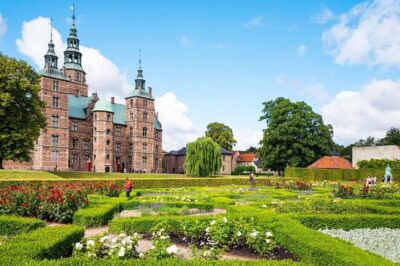
I love the mix of iconic landmarks and real institutions. You’ll see the exterior of Rosenborg Castle (Dutch Renaissance style, built under King Christian IV) and then hit culture and design stops like the Black Diamond (Royal Danish Library extension) built in 1999 with black granite from Zimbabwe.
One thing to consider: the itinerary is packed, so you’ll get quick looks. This is great for orientation, but if you want to linger inside museums for long stretches, plan extra time later.
In This Review
- Key points you should care about
- The pace: how a “highlights” tour still feels organized
- Price and what you actually get for $61.40
- Meeting point and route flow: Banegårdspladsen to a full circle
- Opening sights around Tivoli, art, and the plant collection
- Rosenborg Castle: the outside you want to see twice
- The Little Mermaid: bronze, granite, and the details people miss
- Danish Resistance Museum and Gefion Fountain: two very different stories
- Amalienborg guard change at midday: what you need to know
- Frederiks Church (the Marble Church) and the dome overhead
- Christiansborg: where Parliament meets and ruins sit below
- Opera photos, Børsen dragons, and canal-side Christianshavn views
- Art and church stops: Holmens Church and Kongens Nytorv
- The Black Diamond and Langebro: modern Copenhagen’s real face
- Nyhavn: the harbor postcard with Andersen and WWII memory
- What guides get right: clear storytelling and a pace that respects your time
- Should you book this Copenhagen tour?
- FAQ
- FAQ
- How long is the Grand Tour of Copenhagen?
- How much does it cost, and what’s included?
- Do I need lunch for this tour?
- Where do we meet, and when does the tour start?
- Is pickup offered?
- Can I cancel for a refund?
Key points you should care about
- Small group size (max 33): easier conversation and less waiting at each stop.
- Smart mix of exterior views and short inside moments: you see famous places without spending your whole day indoors.
- Midday guard change at Amalienborg: a classic spectacle timed for the royal routine.
- Mermaid viewing at low tide: the bronze statue is accessible from the granite rock when conditions allow.
- Stop-and-learn format: you’ll hear context on everything from Tycho Brahe to Danish resistance history.
- Good value for short stays: the price targets people with limited time who still want major highlights.
The pace: how a “highlights” tour still feels organized
This is the kind of tour that works when you only have a morning (or a same-day cruise buffer) and you want Copenhagen’s most recognizable sights in one loop. The official duration is about 2 hours 30 minutes, though it can run up to 3 hours, and the pacing matches that reality: you get guided context, then enough time to look around, take photos, and move on.
What helps is that the tour doesn’t rely only on walking. You’re in an air-conditioned vehicle with WiFi on board, and you also have an audio-guide to keep you grounded when you’re on the move. When the group bounces between neighborhoods, this matters more than it sounds. You avoid the “bus ride + lost in translation” feeling, because the guide and audio keep the story clear.
If your priority is “big sights, minimal logistics,” this format is a strong fit. You’ll cover royal buildings, canals, harbor scenes, and at least a few deeper stops that go beyond postcards.
More crowns, courtyards and royal Copenhagen


Price and what you actually get for $61.40
At $61.40 per person, you’re buying a guided loop of major Copenhagen highlights plus transportation. The included items are practical: air-conditioned vehicle, WiFi on board, audio-guide, and a host/driver. Pickup is offered, and you’ll use a mobile ticket.
You’re not paying for a leisurely half-day of free time. You’re paying for efficiency and interpretation. That distinction is the value.
Also, note what’s not included: lunch. So treat this as a sights-and-stories morning. If you’re planning food, either eat before you start at 9:30 am or plan a post-tour meal. For the time window this covers, lunch isn’t the missing piece—it’s more about not being surprised by it.
Meeting point and route flow: Banegårdspladsen to a full circle
You meet at Banegårdspladsen 2, 1570 København, Denmark, starting at 9:30 am. The tour ends back at the meeting point, so you don’t need a second plan for getting home (or to your next stop).
The route is built to hit famous places in an order that makes sense geographically: it starts near central Copenhagen, then works through the royal and harbor zones. The stops you can recognize right away include the Little Mermaid, Amalienborg (guard change), Rosenborg Castle, Christiansborg, and Nyhavn. You also get several “in-between” landmarks that help the city feel connected instead of scattered.
With a maximum group size of 33, you’re not likely to feel like you’re in a huge moving crowd. You still should expect some walking and timing—especially around the guard change at Amalienborg.
Opening sights around Tivoli, art, and the plant collection

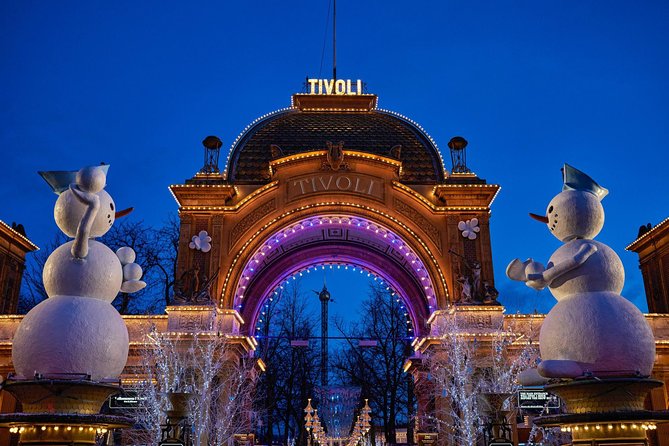
The early part of the tour introduces Copenhagen’s mix of entertainment, art, and science. You begin with the Tivoli Gardens, which opened in 1843 under Georg Carstensen. Even if you don’t go inside, it’s a useful first landmark because it sets the tone: this is a city that’s comfortable blending culture with everyday life.
Next, you pass an art museum setting connected to antique sculptures from the Mediterranean and French and Danish works from the 19th century. This stop works best for two reasons: it provides an art anchor early, and it keeps you from feeling like the tour is only about kings, queens, and castles.
Then comes a very Copenhagen-style detour into nature and observation: the State Natural History Museum’s plant collection, which is Denmark’s largest plant collection spread over 10 hectares. You’ll also hear about specific elements such as the Palm House, and statues/works including Athena and Marsyas by Myron. On the same theme, you visit the Astronomical Observatory / Østervold Observatory, with Tycho Brahe (1546–1601) tied to the story of Denmark’s scientific legacy.
This cluster is the tour’s early “context builder.” If you’ve ever felt like a sightseeing day in Copenhagen can turn into only shiny exteriors, this part helps balance the day.
Rosenborg Castle: the outside you want to see twice
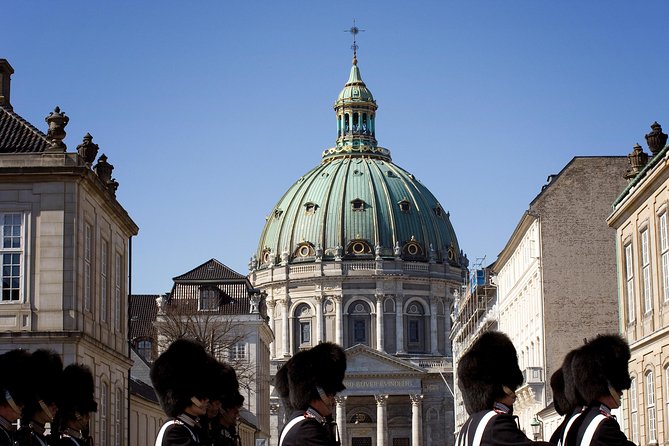
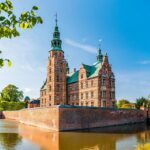
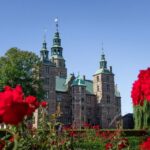
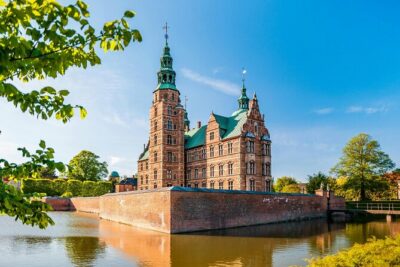
Rosenborg Castle is one of those places where the outside tells the story. It was built in Dutch Renaissance style by King Christian IV, and the exterior is described as being exactly the same as the day it was built. That’s a powerful detail because it means your photo from the street isn’t just a postcard—it’s tied to a preserved visual impression of how it looked at the start.
On a tour like this, you won’t have time to become a full Rosenborg expert. But you do get a high-impact introduction that makes the rest of the royal sites make more sense. Once you understand Christian IV’s influence, the buildings around the city feel less random.
Practical tip: if you’re the type who likes to zoom in on architecture, bring your camera strap and keep your focus flexible. This tour moves quickly, and Rosenborg is the kind of stop you may want to re-check from a couple angles.



The Little Mermaid: bronze, granite, and the details people miss
The Little Mermaid stop is fast, but it’s also the most famous “read the story” moment on the route. The statue has been sitting on her rock since 1913. She was a gift from Carl Jacobsen, the founder of Carlsberg Brewery, and the sculpture is by Edvard Eriksen. It’s bronze on a granite rock that’s accessible at low tide.
What makes this stop interesting on a guided tour is the layers of meaning:
- It’s inspired by Hans Christian Andersen’s mermaid story (a mermaid who falls in love with a human prince).
- The sculpture has been attacked before: it has been beheaded twice, had an arm cut off, and has been splattered with red paint.
- In more recent years, words reading Free Hong Kong were painted on her.
You’re not being asked to remember all of it. The guide and audio give you the punchlines, which is exactly what you want when the stop is short. If you time it wrong and the tide isn’t right, you still get the iconic view; the accessibility detail is just a bonus when conditions allow.
Since the statue viewing is marked as Admission Ticket Free, it’s also one of the easiest “high impact, low effort” stops in Copenhagen.
Danish Resistance Museum and Gefion Fountain: two very different stories
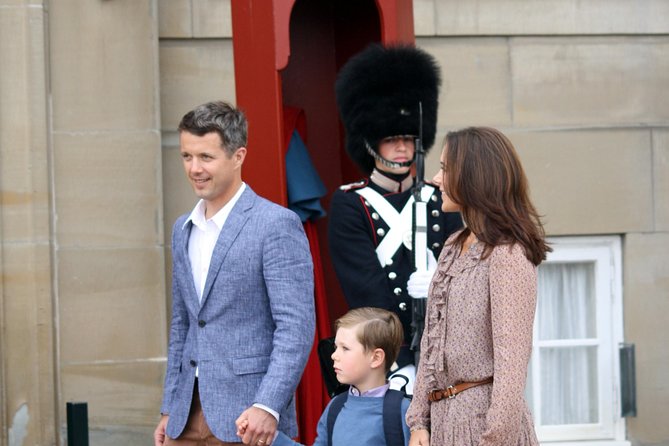
Right after the mermaid, the tour heads into history with the Danish Resistance Museum, housed underground in a new building that opened in 2020. The older museum building burned down in 2013, but most items in the collection were saved. The museum centers on life under German occupation from 1940 to 1945, with a focus on Danish resistance groups.
This stop is valuable because it changes the tone of the city tour. Instead of only admiring buildings, you get context for what happened in them, and what ordinary people did during the occupation. Even with limited time, the underground setting makes the topic feel grounded.
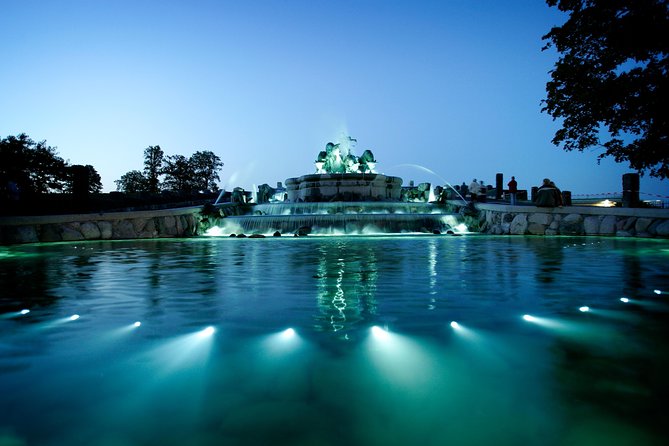
Then you shift again with the Gefion Fountain, dedicated to the goddess Gefion. The story is mythic: she turns her sons into oxen and ploughs the island of Sjælland out of earth from Sweden. The fountain was funded by the Carlsberg Foundation and designed by Danish sculptor Anders Bundgaard (1897–1899). The basin was completed in 1908, and the fountain was first activated that same year.
If you like symbolism, this fountain is a quick win. It links Carlsberg again through funding, which subtly connects Copenhagen’s modern corporate roots to its arts and public art legacy.
Amalienborg guard change at midday: what you need to know
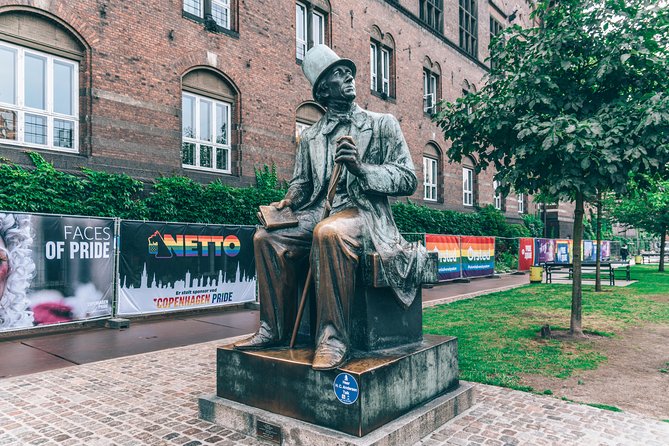
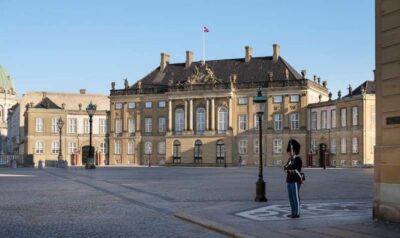
This part is the “watch it happen” segment. The tour includes the changing of her Majesty’s guard at Amalienborg Castle at midday. It’s listed with about 20 minutes for the stop, and Amalienborg’s palaces date back to the 1760s, with the royal family moving in in 1794 after Christiansborg Palace burned down.
There are four palaces at Amalienborg: Christian VI’s Palace, Christian VIII’s Palace, Frederik VIII’s Palace, and Christian IX’s Palace. The tour notes that Frederik VIII’s Palace is where King Frederik X and Queen Mary stay when they’re in Copenhagen.
So what’s practical here? You’re not just seeing a uniform change. You’re seeing a routine that’s tied to a specific palace complex with a specific daily timing. If you want photos, this is the one stop where you should position yourself early and accept that you may not get the perfect angle—but you’ll get the moment.
Frederiks Church (the Marble Church) and the dome overhead
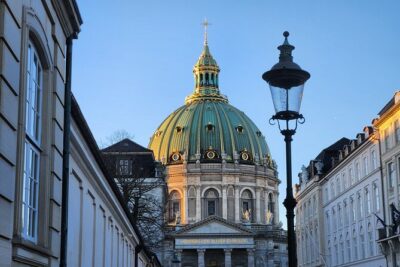
Next is the Marble Church, officially Frederiks Church. It was commissioned by King Frederik V and designed by Nicolai Eigtved in 1740. Construction began but slowed when Eigtved died in 1754, with work stopping in 1770. Later, Ferdinand Meldahl took over design. Due to a restricted budget, the remaining portion was built using limestone instead of marble.
One detail you can’t miss: the dome is described as the third largest in Europe. On a tour stop like this, you may not go inside, but you’ll likely get enough exterior time to appreciate the scale. It also helps the city make sense visually. Copenhagen has plenty of waterfront charm, but this kind of monumental church is what gives the skyline weight.
Christiansborg: where Parliament meets and ruins sit below
Christiansborg is both government and layers of older Copenhagen. The present building dates to 1928, and it’s where Denmark’s parliament, the Folketing, meets. Below, you can find ruins of an earlier Copenhagen Castle built in 1167 by Bishop Absalon. The first Christiansborg Palace was built by King Christian VI in 1740.
In 1992, Christiansborg Church’s roof caught fire, and repairs were completed in 1997. There’s also a modern royal connection: Christiansborg is where King Frederik X’s throne is found, and he waved from the balcony during his installation by Prime Minister Mette Frederiksen. Denmark has no coronations, so this is the kind of ceremonial detail that’s easy to overlook if you visit on your own.
On this tour, you’re not getting a long architectural lecture. You’re getting the map of what you’re looking at: parliament above, older castle ruins below, church restoration story in between.
There’s also a quick stop at a museum by the canal connected to the grave of Bertel Thorvaldsen. Thorvaldsen is one of Denmark’s major artists, and this kind of stop works because it turns “pretty canal moment” into a real cultural marker.
Opera photos, Børsen dragons, and canal-side Christianshavn views
The route continues with a brief stop at Det Kongelige Teater – Operaen, where you can take photos of Copenhagen harbor and the Amalienborg palace area. The tour is short here, but photo access matters—this is one of those sections where you can collect the skyline views you’ll want later.
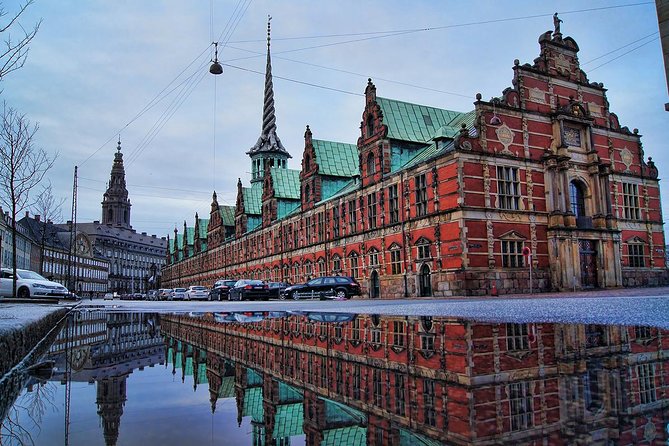
Then it moves to an equestrian statue of the city’s founder, Bishop Absalon (noted as from 1902). After that comes Børsen, the old stock exchange building dating back to the 1620s, built by King Christian IV. The building’s upper floors originally served as a marketplace for physical commodities. Right now, it’s owned by Dansk Erhverv, and the spire above the building is made of intertwined dragons’ tails.
From there, you reach Christianshavn, with a canal overlook and Our Saviour’s Church in the view. This neighborhood stop helps because it shifts you from “royal monument mode” to “canal neighborhood mode.”
Art and church stops: Holmens Church and Kongens Nytorv
The tour includes several cultural stops in this stretch:
- A mansion from the 18th century with collections and exhibitions about Denmark’s history, its people, and culture.
- The Danish National Gallery, which has international collections, temporary exhibitions, and children’s activities.
Even if you don’t go deep inside on a quick tour day, these are helpful because they show what Copenhagen is investing in. It’s not only a city of historic façades; it’s actively curating.
Then you hit Holmens Church, built in 1619 in a former anchor forge by King Christian IV. It serves both as a parish church and as the church dedicated to and used by the Danish Royal Navy. It’s described as the only church in Denmark next to sea water, with naval officer accommodation historically near Bremerholm. Inside, there are models of ships hanging from the ceiling—an unusual detail that makes the church feel connected to its original purpose.
After that is Kongens Nytorv, commissioned in 1670 by King Christian V. It was inspired by Place d’Vendôme in Paris and designed as a central square between Strøget and Nyhavn. The statue in the middle is of Christian V (placed 1688), and it’s described as the oldest royal statue in Copenhagen. Around it are the Royal Theatre and the Royal Academy of Arts in the former Charlottenborg Palace.
This is a strong sequence: church + navy link, then square + royal city planning.
The Black Diamond and Langebro: modern Copenhagen’s real face
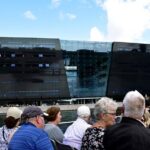
One of the best mid-to-late highlights is the Black Diamond, home to the extension of the Royal Danish Library. It was built in 1999 and designed by Schmidt, Hammer and Larsen. The building is made of black granite from Zimbabwe, attached by a bridge to the main library building built in 1906 by Hans J. Holm. The library extension includes reading room and music room, plus a cafe and bookshop.
If you only associate Copenhagen with older architecture, this stop resets your expectations. You see how modern design fits right into the city’s cultural role.
Then comes Langebro, a bridge that opens for large ships passing through the harbor. It was built in 1954, designed by Kaj Gottlob, and it’s owned by Copenhagen City Council. Its dimensions are listed as 7 meters high and 35 meters long. The tour also notes the earlier bridge (wooden) from 1690 built by King Christian V. In 2019, concrete damage from rainwater was found, and repairs were set to cost 307 million Kroner (about €40 million). Even if you don’t get a deep engineering explanation, you do get a sense of how active and working the harbor is.
Nyhavn: the harbor postcard with Andersen and WWII memory
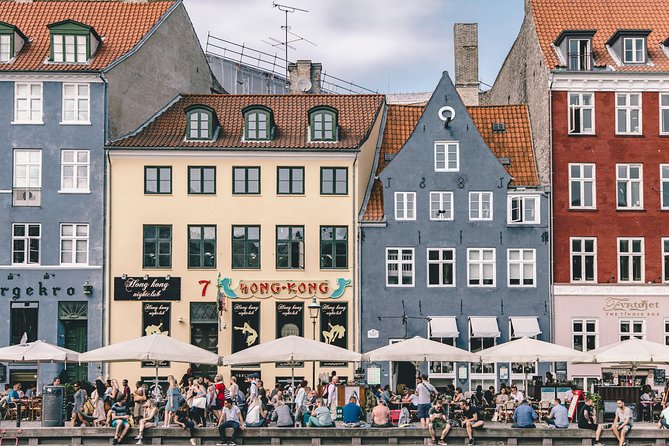
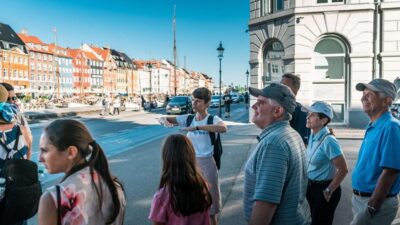
Nyhavn is one of the most satisfying ends to a tour like this because it gives you the classic canal-and-harbor feel. Nyhavn was built between 1671 and 1673 by Swedish prisoners of war, and the oldest house is Nyhavn 9 from 1681. The tour notes that in the 1970s it was rougher, then renovated in the 1980s, and today it’s full of restaurants and pavement cafés.
If you like literature, you’ll appreciate the Hans Christian Andersen connection. He lived in Nyhavn at different times in numbers 18, 20, and 67. And at the end of Nyhavn, there’s a memorial anchor placed in 1951 honoring Danish merchant seamen who lost their lives during World War II.
This stop works best if you use it for what it’s good at: letting the day sink in. With so many big landmarks earlier, Nyhavn gives you a more human scale and a place to slow down for a few minutes, even if the tour day itself doesn’t.
What guides get right: clear storytelling and a pace that respects your time
A big reason this tour rates highly is the guidance style. In guide reports, Christian and Peter are specifically called out for being friendly, clear, and exceptionally informative. The other theme is pace: the tour feels structured, not rushed, with time to learn and still enjoy the sights.
That matters because Copenhagen can overwhelm people fast. Too many stops without a thread equals confusion. Here, the thread is what ties the sights together: royal influence, public art funded by notable institutions, and the way historical events shaped the city.
Should you book this Copenhagen tour?
Book it if:
- You have limited time and want a fast orientation from the Little Mermaid to royal central Copenhagen.
- You like a guided, structured route more than choosing everything yourself.
- You want a morning plan that helps you connect major sites like Amalienborg, Christiansborg, and Nyhavn.
Skip or save it for later if:
- You want long museum stays or deep interior time at multiple stops. This route is built for short, high-impact looks.
- Your day needs lots of flexible downtime. The itinerary is packed by design.
FAQ
FAQ
How long is the Grand Tour of Copenhagen?
It runs about 2 hours 30 minutes, and it can take up to 3 hours.
How much does it cost, and what’s included?
It costs $61.40 per person. Included are an air-conditioned vehicle, WiFi on board, an audio-guide, and a host/driver.
Do I need lunch for this tour?
Lunch is not included, so you’ll want to plan food either before or after the tour.
Where do we meet, and when does the tour start?
The meeting point is Banegårdspladsen 2, 1570 København, Denmark, and the start time is 9:30 am.
Is pickup offered?
Yes, pickup is offered.
Can I cancel for a refund?
Yes. You can cancel up to 24 hours in advance for a full refund. If the minimum number of travelers isn’t met, you’ll be offered a different date/experience or a full refund.
More Tours in Copenhagen
More Tour Reviews in Copenhagen
More Royal Copenhagen
Fresh Off the Cobbles: The Newest Copenhagen Reviews







Royal Palaces & Rosenborg Castle, compared.
 ★ 5.0Walk & Canal Tour: Copenhagen Highlights + Changing of the GuardsFrom $77580 reviews
 ★ 4.6Rosenborg Castle Entry TicketFrom $23381 reviews
 ★ 5.0Full-Day; Castle, Palace, Cathedral & Viking ships TourFrom $217326 reviews
 ★ 4.3Amalienborg Palace Museum Entry TicketFrom $19291 reviews
 ★ 4.6Copenhagen City & Christiansborg Palace Private Walking TourFrom $73123 reviews
 ★ 3.5Rosenborg Castle Entry Ticket in CopenhagenFrom $3822 reviews
 ★ 4.8Full-Day Tour; Castle, Palace, Cathedral and Viking ShipsFrom $25921 reviews
 ★ 5.0Private Copenhagen City Tour with Rosenborg CastleFrom $51114 reviews
Browse the lists this tour appears in